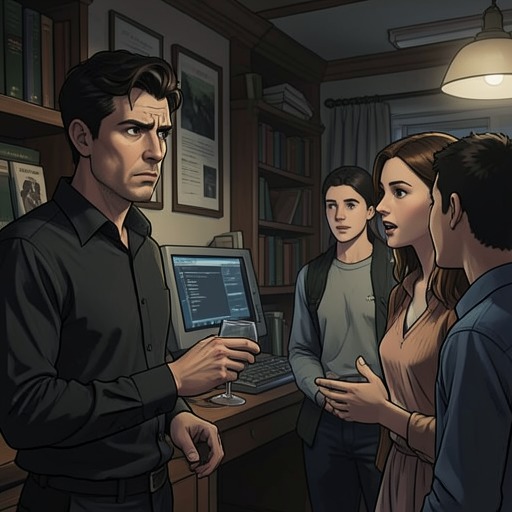
Jonathan’s recurring mental-health crisis
Dark Lies the IslandJonathan’s recurring mental-health crisis is a pattern of psychological distress that intensifies around fears for his daughter Ellie and repeatedly overwhelms his ability to separate protective concern from destabilizing suspicion. The novel connects the crisis to sleeplessness, intrusive images and sounds, and conflict at home; at Do-It-Rite!, Jonathan’s attempt to protect Ellie becomes an alarming display of control, making the breakdown visible not only in his perceptions but in the harm his conduct can cause.
Identity and Pattern
Jonathan’s crisis is presented as recurring rather than as a single episode. When Saoirse urges him to speak with Doctor Murtagh, she frames his condition as a possible return of a breakdown and recommends cognitive therapy and medication. Her response establishes that this distress is familiar within their marriage, even though the evidence here does not specify the history or details of earlier episodes.
The crisis gathers force around Jonathan’s belief that Ellie and Aodhan McAdam are sexually involved. He says he can smell what is happening, treating suspicion as though it were direct perception. Saoirse’s attempts to address the situation meet his distress without confirming his certainty. His concern for Ellie is real, but the way it takes hold of him becomes difficult to contain.
Escalation at Home
Jonathan’s perception of the household changes as his anxiety escalates. He imagines hearing Aodhan chewing throughout the house, an ordinary bodily sound rendered intrusive and impossible to ignore. The impression reflects the crisis’s reach: the threat he associates with Aodhan seems to spread beyond the young man and into the domestic space itself.
The distress also appears in Jonathan’s reactions to the graffiti about Ellie. Seeing her identified by the initial P of his late father’s surname, Prendergast, he walks the length of the pier and back three times. On a busy summer evening, he ignores the neighbors, cries, grinds his teeth, and smokes a pack of cigarettes. The episode links his fixation on Ellie’s humiliation to a public, repetitive effort to discharge feelings he cannot otherwise settle.
Sleep becomes another point of deterioration. Jonathan says he hardly sleeps, and an incessant buzzing in his head accompanies a rush of images of Ellie and Aodhan. The following morning he goes to Ellie’s room intending to lecture her about respect for herself and the family home. Instead, he finds her sobbing. His anger and self-righteousness collapse in the face of her distress, which he describes as devastating to him.
Family Relationships and Strain
Saoirse recognizes Jonathan’s condition as a crisis requiring help, telling him to speak to Doctor Murtagh and naming therapy and medication as possibilities. Her response sets practical support against Jonathan’s escalating certainty: she does not endorse his belief that he knows what Ellie and Aodhan are doing, but tries to direct him toward treatment. The exchange shows how his mental state is also a marital problem, placing Saoirse in the position of confronting and managing a recurrence while coping with her own difficulties.
Jonathan’s concern for Ellie is bound up with his sense of parental responsibility and with a fear that she may be hurt. Yet his distress compromises his judgment. He enters her room prepared to speak about respect, only to encounter her in tears; later, he carries his protective feelings into a confrontation with Aodhan that exceeds a calm warning. The movement from concern to threat gives the crisis a relational consequence: his attempt to safeguard his daughter risks making him another source of fear.
Do-It-Rite! and Loss of Control
At Do-It-Rite!, Jonathan approaches Aodhan in a quiet aisle and speaks from what he presents as personal experience, acknowledging that young people have sexual relationships and objecting to the way Ellie is being treated. But the conversation turns coercive. When Aodhan tries to leave, Jonathan restrains him, warns that he will kill him if he hurts Ellie, and slaps him. He then recounts his own psychological experiences and the frightening images and voices he has encountered, bringing his private crisis directly into the confrontation.
Jonathan’s account of his distress is mixed with an effort to frighten Aodhan into compliance. He describes darkness entering the gaps of a life and says that Saoirse has been plagued at night by evil fairies; he also elevates Ellie into a figure to be worshipped and protected at any cost. The speech reveals how care, fear, and disordered perception have become entangled. Aodhan’s sobbed disclosure that he has Type 1 diabetes does not stop Jonathan’s pressure. Jonathan leads him through the store to the paint racks, sets a spot check for the rain shelter at seven, and orders him to appear on the porch at eight in his usual clothes.
The confrontation ends with the arrival of a squad car. Its appearance makes the public consequence of Jonathan’s loss of control unmistakable: what began as a father’s response to perceived mistreatment has become a scene serious enough to draw police attention. The episode does not resolve the underlying crisis; instead, it shows how Jonathan’s protective objective can escalate into intimidation and intervention by others.
Narrative Significance
The crisis is conveyed through a progression of ordinary surroundings made unstable: the home seems filled with a sound Jonathan cannot dismiss, the pier becomes the setting for repetitive agitation, and a hardware-store aisle becomes the stage for a threat. These settings give concrete form to the spread of his distress without making his perceptions reliable evidence of what Ellie and Aodhan have done.
A recurring tension structures Jonathan’s actions: he wants to protect Ellie, yet the more completely he acts on suspicion, the more his behavior departs from the measured protection he imagines himself providing. The novel’s sequence—from Saoirse’s recommendation of professional help, through sleeplessness and intrusive imagery, to the confrontation and squad car—presents the breakdown as both inward suffering and outward consequence. It leaves the conflict unresolved, with the arrival of the police marking an interruption rather than recovery.